Professional woodworker Joshua Kou considers cutting board oil one of the most important tools for protecting that surface. Regular conditioning helps prevent the wood from becoming excessively dry—a condition that can eventually contribute to roughness, splitting and warping.
Why washing and drying are not enough
Every time a board is washed, the wood absorbs some moisture. As it dries, that moisture leaves again. Repeated expansion and contraction can place stress on the fibers, particularly when one side dries faster than the other.
The One Product a Woodworker Says Every Wooden Cutting Board Needs
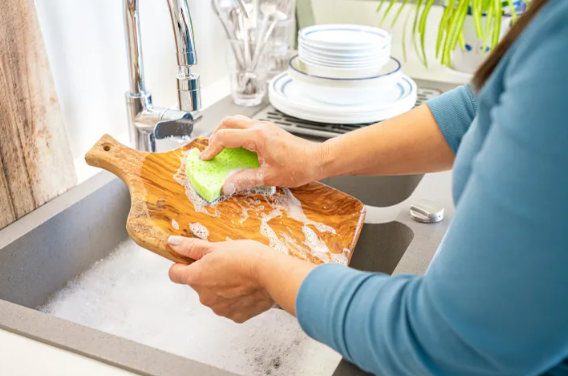
The USDA recommends washing cutting boards with hot, soapy water after use, rinsing them and allowing them to air-dry or patting them dry. For a wooden board, it is also sensible to expose both surfaces to air rather than leaving one wet side flat against the counter.
Drying protects the board from excessive moisture, but conditioning addresses the opposite problem. A suitable oil penetrates the wood and helps slow the rapid exchange of moisture with the surrounding environment.
The plant-based oil Kou recommends
Kou’s preferred option is Real Milk Paint Cutting Board Oil, sometimes listed under the company’s RMP Finishes branding. The product is made with refined almond oil, palm fruit oil, grapefruit seed oil, rice wax and hemp floral wax.
The formula is designed for surfaces that come into contact with food. Unlike ordinary kitchen oils, which can oxidize and become rancid, a purpose-made board treatment is formulated to remain stable on the wood.
The waxes in this blend also help the finish set instead of leaving the board perpetually greasy. That can reduce the oily marks sometimes transferred to counters or shelving immediately after conditioning.
How to condition a cutting board correctly
- Wash the board with warm water and dish soap.
- Rinse it thoroughly and remove surface water with a clean towel.
- Stand it upright so air reaches both sides.
- Wait until the board is completely dry.
- Apply a small quantity of oil with a clean, lint-free cloth.
- Work it across the face, edges, corners and any handle opening.
- Allow the finish to absorb according to the product directions.
- Remove any excess before returning the board to storage.
New, unfinished boards may absorb more than well-maintained ones. Rather than following an arbitrary weekly schedule, watch the surface. A pale, dry or noticeably rough board is asking for attention.
Products that should stay in the pantry
Olive, vegetable, sunflower and similar cooking oils are not reliable board treatments because they can become rancid and produce unpleasant odors. Household furniture polish is also unsuitable for a food-preparation surface.
Check the complete ingredient list before using any finish. Because this particular product contains refined almond oil, people managing severe tree-nut allergies may prefer to consult the manufacturer or choose a clearly labeled alternative appropriate for their household.
Oil cannot repair a board with deep cracks, loose joints or extensive damage. Those boards may need professional refinishing or replacement. For a board that is still structurally sound, however, routine conditioning is a modest investment that can preserve its appearance, feel and usefulness for much longer.