My freezer used to function less like food storage and more like an archaeological site. Half-open vegetable bags disappeared beneath mystery containers, while carefully saved soup became impossible to identify after a few weeks.
The problem was not simply a lack of space. I was using the same container for every type of food. Once I matched soups, leftovers and small ingredients with storage designed for their shapes, the freezer became easier to organize—and the food was far more likely to be eaten.
Souper Cubes for portioned meals
Souper Cubes freezer molds divide soup, broth, chili, sauces and cooked grains into measured portions. The one-cup version is particularly useful for individual meals or ingredients that will later be added to a recipe.
After the food freezes solid, the blocks can remain in the covered mold or be transferred to a labeled freezer bag. Neatly shaped portions stack more efficiently than a collection of round containers filled to different levels.
Do not fill the compartments beyond the indicated line. Liquids expand as they freeze and need room to move.
Bentgo glass containers for complete meals
For casseroles, curries and composed leftovers, Bentgo glass storage containers provide a clear view of what is inside. Their straight-sided shapes stack neatly, while locking lids help limit air exposure and leaks.
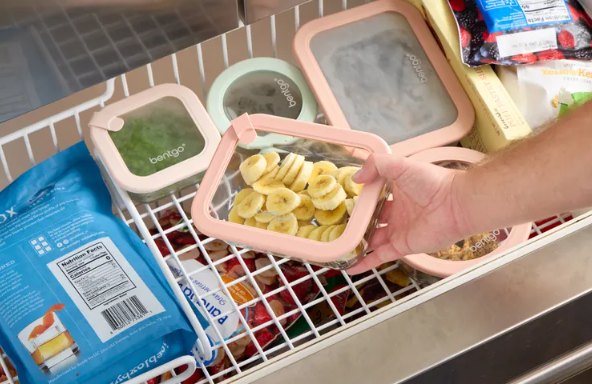
These Freezer Containers Finally Brought Order to My Frozen-Food Disaster
The glass bases are designed for freezer, microwave, oven and dishwasher use, although lids may have different temperature restrictions. Never move frozen glass directly into a hot oven unless the manufacturer specifically approves that transition. Sudden temperature changes can damage glass.
Stasher bags for awkward and smaller foods
Rigid containers are inefficient for bread, tortillas, fruit pieces and small quantities of ingredients. Stasher reusable silicone bags fit into narrow spaces and can be stored upright once partially frozen.
Press out excess air before sealing, but avoid crushing delicate food. Freeze berries or sliced vegetables in a single layer first if you want the pieces to remain separate.
Wire bins create practical freezer zones
Containers preserve food; open bins preserve the system. I use separate zones for vegetables, proteins, prepared meals and baking ingredients. Because wire baskets allow cold air to circulate and reveal their contents, they are often more practical than deep, opaque organizers.
Measure the freezer before buying bins. Leave clearance around vents and avoid packing shelves so tightly that cold air cannot circulate.
Labels are more important than matching containers
Every item receives a name and freezing date. “Red sauce” is more useful than no label, but “tomato-lentil sauce—August 27” is better. Freezer-safe tape and a permanent marker turn an anonymous block into a future dinner.
Proper packaging helps preserve quality and reduce freezer burn, which occurs when air reaches the surface and draws out moisture. According to FoodSafety.gov, foods continuously stored at 0°F (-18°C) remain safe indefinitely, but recommended storage periods concern flavor and quality. Many cooked leftovers are at their best within roughly two to six months.
Containers cannot refresh food that was mishandled before freezing. Refrigerate or freeze perishable leftovers within two hours, use shallow portions for faster cooling and reheat appropriate leftovers to 165°F.
The biggest improvement was not making the freezer look perfect. It was being able to see what I owned, remove one useful portion and return everything else without triggering an avalanche.